Rethinking Wealth, Community, and Contribution
How we relate to the material world
Calebe de Roure
5/13/20263 min read
One of the questions we often reflect on at PlantaVida is this:
What would an economy designed around human growth actually look like?
Modern society tends to separate many aspects of life from one another. Work becomes disconnected from purpose. Wealth becomes disconnected from community. Success becomes disconnected from wellbeing.
At the same time, many people feel trapped between two extremes.
On one side, there is a mainstream culture focused heavily on consumption, competition, and individual achievement. On the other, there are alternative spaces that sometimes reject money altogether, as if spirituality and prosperity cannot coexist.
At PlantaVida, we believe there is another possibility.
We believe abundance and consciousness can walk together.
Prosperity Is Not the Enemy
There is often discomfort around money in spiritual and conscious communities. Many people carry the idea that seeking prosperity somehow conflicts with authenticity, healing, or service.
But money itself is not the problem.
Money is simply energy, exchange, and possibility.
Like any tool, it can be used unconsciously or consciously.
At PlantaVida, we do not see abundance as something shameful. We see it as a blessing that comes with responsibility. To us, prosperity means having enough not only to live well, but also to contribute, create opportunities, support others, and expand projects that benefit life.
We are not interested in luxury for the sake of status.
We are interested in creating beauty, health, and sustainability.
There is a difference.
Contribution Takes Many Forms
One of the challenges in building intentional communities is creating systems that are both accessible and sustainable.
Some people have financial resources but little free time.
Others have time, energy, creativity, and skills but limited money.
Both forms of contribution matter.
At PlantaVida, we aim to create multiple pathways into the ecosystem.
Some people may come as paying guests for a short stay, retreat, or event. Others may volunteer, contribute to projects, or help build the community over longer periods of time.
What matters most is not simply how much money someone has.
What matters is their willingness to participate, contribute, and grow.
We believe healthy communities are built when people feel they have something meaningful to offer one another.
Moving Beyond Passive Consumption
Many modern experiences are designed around consumption.
People pay, receive a service, and leave unchanged in how they relate to others or to life itself.
Our vision is different.
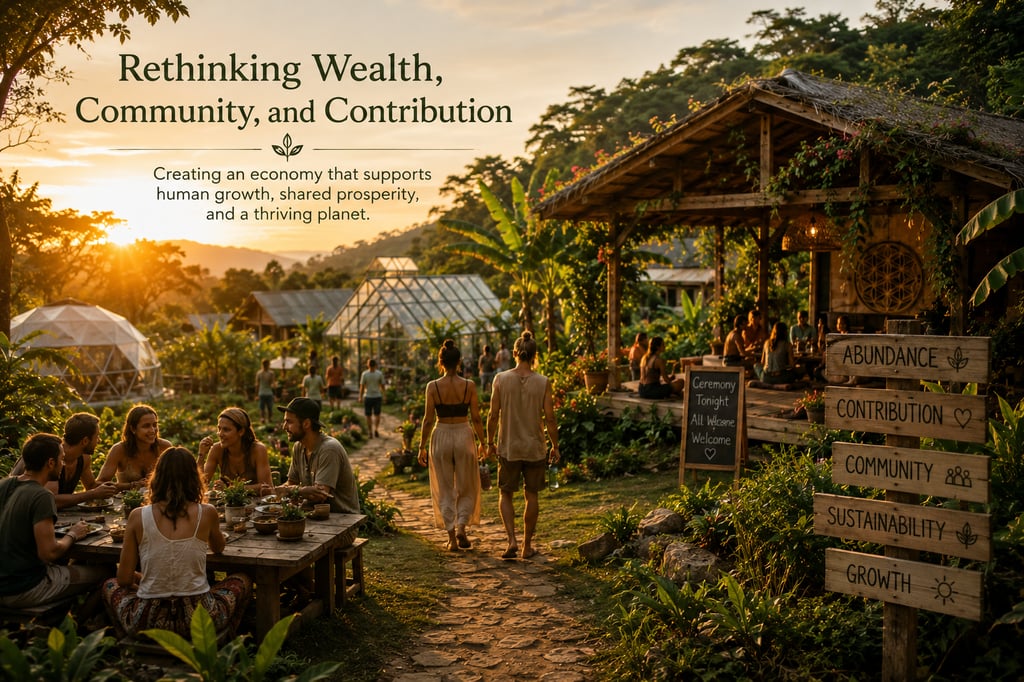
PlantaVida is not intended to become a place where people only consume experiences. We hope it becomes a place where people participate in creating culture together.
This may happen through:
hospitality,
volunteering,
workshops,
business creation,
ecological projects,
ceremonies,
art,
cooking,
building,
teaching,
healing,
or simply showing up consistently for community life.
In this sense, contribution is not only economic.
It is relational.
Entrepreneurship and Community
Another important part of our vision is entrepreneurship.
Historically, many intentional communities struggled because they lacked sustainable economic foundations. They depended heavily on idealism without creating systems capable of supporting long-term life.
At PlantaVida, we believe businesses can be part of healing when they are aligned with values.
We imagine an ecosystem where people can:
create meaningful work,
support themselves financially,
collaborate with others,
and contribute to a larger vision at the same time.
Some businesses may focus on hospitality.
Others may focus on natural building, food production, wellness, education, art, or regenerative practices.
Economic sustainability is not separate from the vision.
It is part of the vision.
Stewardship Instead of Ownership
We also reflect deeply on our relationship with land.
Modern culture often teaches us to think of land primarily as property: something to own, divide, and extract value from.
We prefer another perspective.
At PlantaVida, we see ourselves as custodians rather than owners. The land is not simply a financial asset. It is the foundation that allows community, healing, and connection to emerge.
In the future, people who become long-term members of PlantaVida may participate in stewardship of the land and the broader ecosystem. But more important than legal ownership is the spirit of responsibility and care.
The deeper question is not:
“What can I take from this place?”
The deeper question is:
“How can I help this place flourish for future generations?”
Building an Economy Around Human Flourishing
Ultimately, PlantaVida is an exploration.
Can we create an environment where:
prosperity and spirituality coexist,
business and ecology support one another,
contribution is valued,
and community becomes part of daily life again?
We do not claim to have all the answers.
But we believe these questions are worth asking.
Perhaps many people are not only searching for better jobs, better houses, or better products.
Perhaps they are searching for:
belonging,
meaning,
purpose,
connection,
and healthier ways of living together.
If that is true, then maybe the future is not only about new technologies or new economies.
Maybe it is also about remembering how to live as human beings again.