Why Place Matters: Rebuilding Community Through Shared Space
The importance of our physical space
Calebe de Roure
5/15/20264 min read
Modern life has given us many things:
speed,
comfort,
technology,
and global connection.
Yet despite being more connected digitally than ever before, many people feel increasingly disconnected in real life.
Disconnected from:
nature,
meaningful community,
shared rituals,
and even from themselves.
At PlantaVida, we often return to one simple realization:
Healing does not happen only inside the individual.
Healing also happens through place.
Where we live shapes:
how we feel,
how we relate,
how we think,
and who we become.
The Importance of Shared Space
One of the great paradoxes of modern society is that many people deeply long for community while living physically isolated lives.
Friendships become occasional.
Families become fragmented.
Neighborhoods become anonymous.
And much of life happens through screens.
But real belonging is not built through a single conversation or a social media post.
Belonging emerges through repeated shared moments.
It grows through:
eating together,
seeing familiar faces,
sharing routines,
helping one another,
dancing together,
working together,
sitting in silence together,
and slowly learning that we are part of something larger than ourselves.
This is one of the reasons physical place matters so deeply.
Community requires proximity.
Between Two Worlds
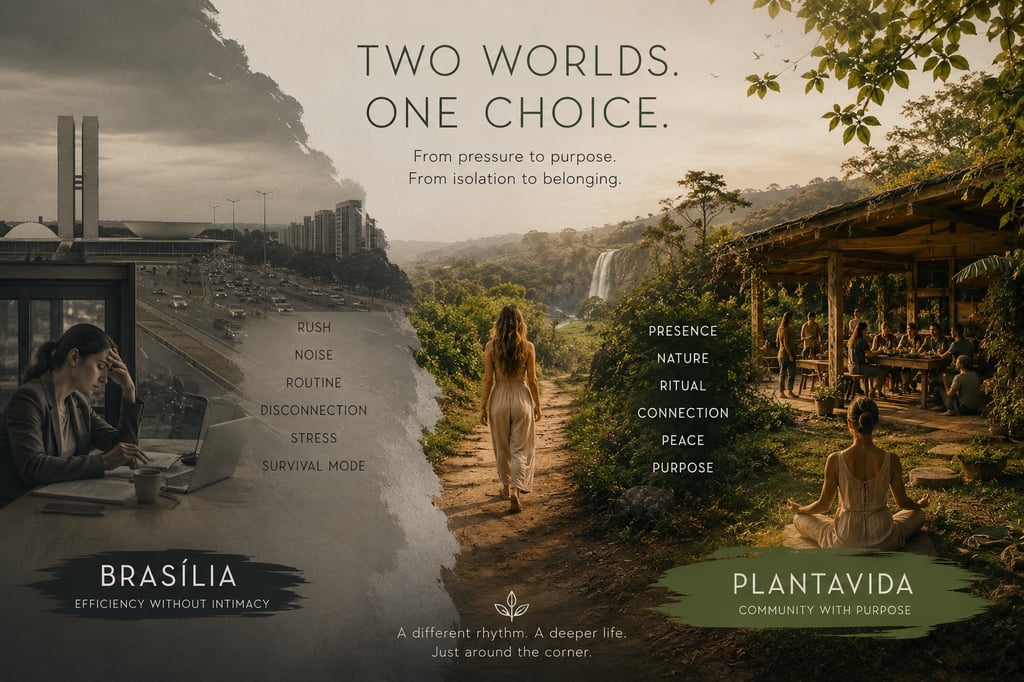
PlantaVida is located near Brasília, close enough to remain connected to modern life, yet surrounded by nature.
This contrast is important.
Brasília represents many of the contradictions of modern society:
efficiency without intimacy,
structure without spontaneity,
comfort without connection,
and productivity without belonging.
Like many modern cities, it is a place where life can become highly functional while still feeling emotionally empty.
People wake up early, commute, work, return home exhausted, and repeat the cycle again the next day. Even surrounded by millions of people, many still feel alone.
PlantaVida is not positioned against Brasília.
In many ways, Brasília makes PlantaVida possible.
The city is the economic engine, the source of opportunity, and home to many people who are already questioning whether another way of living could exist.
What we hope to offer is contrast.
Not escape from society, but reconnection to dimensions of life that modern urban environments often weaken:
nature,
slowness,
ritual,
emotional openness,
shared routines,
and tribe.
One of the unique aspects of PlantaVida is that this transition happens quickly.
Within less than an hour, someone can leave behind the city and arrive in a completely different emotional atmosphere.
The landscape changes.
The pace changes.
The body relaxes.
And slowly, people begin remembering parts of themselves that may have been dormant for a long time.
Nature as Teacher
The land where PlantaVida exists is part of the Brazilian cerrado ecosystem, a biome filled with unique vegetation, rivers, waterfalls, and dramatic seasonal cycles.
In the nearby region of Chapada dos Veadeiros, many people believe the land carries a special energetic quality connected to its crystal-rich geology and strong natural presence.
Whether someone sees this spiritually or simply emotionally, there is no denying that nature affects the human experience.
When people spend time surrounded by trees, water, silence, stars, and open skies, something begins to shift.
The nervous system slows down.
Attention returns to the present moment.
Conversations deepen.
And life begins to feel more human again.
At PlantaVida, we do not want nature to feel like decoration outside a building.
We want people to feel immersed within it.
Architecture That Supports Connection
We also believe the spaces we build influence the way we relate to one another.
Architecture is not only functional.
It is emotional.
Beautiful spaces communicate care.
Warm spaces encourage openness.
Communal spaces create opportunities for connection.
Our vision for PlantaVida combines ecological building methods with modern and intentional design. We are inspired by bio-construction, permaculture principles, natural materials, and architecture that feels integrated with the land rather than imposed on top of it.
The goal is not luxury in the traditional sense.
The goal is harmony.
A place can feel beautiful without becoming excessive.
It can feel grounded while still inspiring awe.
The Heart of Community
At the center of PlantaVida is not a hotel room or private house.
It is the communal space.
The kitchen.
The shared meals.
The fire.
The conversations after sunset.
The workshops.
The music.
The moments where people laugh, cry, dance, reflect, and support one another.
Modern culture often teaches independence above all else.
But human beings have always gathered in circles.
Around food.
Around stories.
Around ritual.
Around shared purpose.
We believe many people today are not only searching for success or comfort.
They are searching for:
belonging,
meaning,
emotional safety,
and the feeling of being part of a tribe again.
A Different Rhythm of Life
Life at PlantaVida is intended to follow a different rhythm from the city.
Morning meditation.
Yoga.
Shared meals.
Work with purpose.
Evening gatherings.
Workshops.
Ceremonies.
Music.
Rest.
Not because everyone must live exactly the same way, but because shared rhythms help create connection.
Over time, repeated routines become culture.
Culture becomes trust.
And trust becomes community.
More Than a Destination
Ultimately, PlantaVida is not simply trying to become a retreat center or an ecovillage.
It is an exploration into a larger question:
What happens when people intentionally design a place around human flourishing instead of only productivity?
We do not claim to have all the answers.
But we believe that place matters.
Beauty matters.
Nature matters.
And community matters.
Perhaps the future many people are longing for is not only about new technology or economic growth.
Perhaps it is also about remembering how to live together again.